Start with clear rules
When inputs are structured and decisions follow clear rules, conventional automation is often enough. Matching an order number or transferring a status does not automatically need a language model.
AI for unstructured inputs
Free text, documents and varied phrasing can make AI useful. Its output remains a proposal that may need review. The system should expose uncertainty instead of hiding it.
Combine the two
A model can classify a request while deterministic rules govern which actions are allowed. This separates flexible interpretation from traceable control.
Compare the full effort
Consider setup, interfaces, review time and ongoing operation. The best solution reliably improves a specific workflow, even if it uses no AI at all.
Three questions before choosing technology
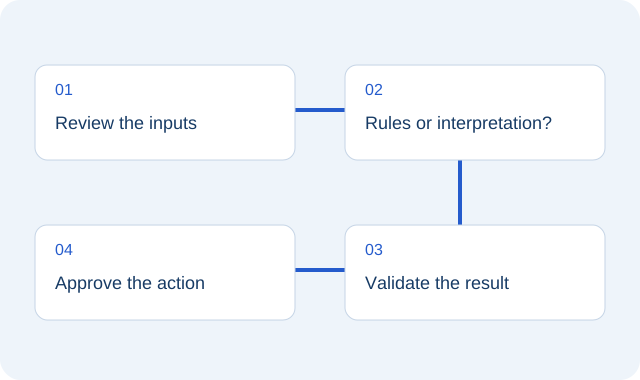
Is the input structured? Can the correct decision be fully described as a rule? Can the result be checked before an action occurs? If the first two answers are yes, begin by considering a rule-based solution. With free-form text, a model can help structure information. Required fields, permissions and thresholds should still be checked using explicit rules.
Example: transferring information from a document
A model might suggest an amount and a purchase order number extracted from an invoice. A separate check validates the format, matches the order and flags discrepancies. An uncertain value is not silently accepted as correct. Missing orders and conflicting amounts remain in a review queue. The model interprets; the process governs permitted actions. This is an illustrative architecture, not a promised product capability.
Exceptions have a cost too
Automation does not become cost-free when it starts running. Interfaces change, input data is incomplete and responsibilities move. AI adds model changes, usage costs and output evaluation. A decision therefore needs more than a development price: consider expected volume, review effort and maintenance. A less automated workflow may be more economical when it is easier to control.
When to improve the process first
If nobody can identify the authoritative data source or the owner of exceptions, the foundations are missing. First clarify responsibilities, required fields and approvals. Document a few real workflows and the reasons for deviations. That work is useful whether the eventual solution is a language model, an integration or a better form in an existing application.