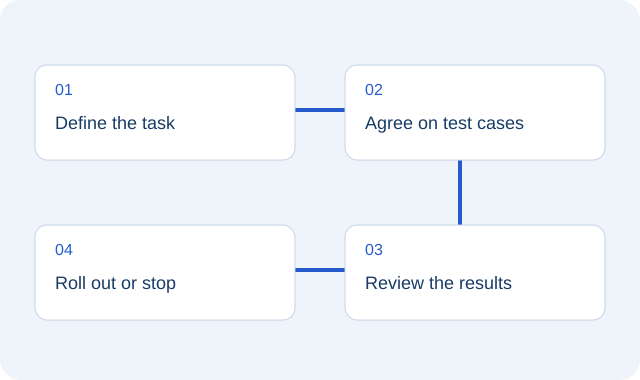
Start with one task
A pilot needs a bounded task. “Improve our customer service” is too broad. “Prepare draft answers for five common questions” can be evaluated with real examples. Define what the system must not do.
Measure the starting point
Record how the work happens today. Which steps take time? Where are corrections needed? Use a representative sample, including difficult cases. Without a baseline, improvement is hard to judge.
Agree on success first
Set quality criteria, acceptable errors and approval steps before testing a model. Time savings only matter when the work is accurate. Document which failures should stop the pilot.
Think about operation
A convincing demonstration is not yet a reliable process. Decide who handles exceptions, updates data and monitors costs. Finish with an informed decision: extend, revise or stop.
Build a test set that reflects daily work
Do not collect only the easiest examples. A useful test set includes ordinary requests, incomplete information, contradictory documents and cases outside the agreed scope. Separate development examples from acceptance cases. Otherwise, the system may appear strong simply because it has been tailored to familiar inputs. For each test, record what an acceptable result looks like and when the system should ask for clarification.
Count the full handling time
Compare the whole workflow, not just the seconds needed to produce a first draft. The new handling time includes reading the suggestion, checking sources, making corrections and dealing with exceptions. A fast draft that needs substantial rework can make the process slower. Measure creation time, review time and the number of corrected results separately. Include cases where the system deliberately declines to answer.
A practical example: the shared inbox
Suppose a team wants to sort incoming requests. A pilot might only suggest a category and a responsible group. It sends no replies and changes no customer records. Reviewers compare each suggestion with a justified assignment and record differences. Additional tasks are considered only after this narrow step works reliably. This is an illustrative test arrangement, not a report about a client engagement.
Finish with a decision record, not just a demonstration
At the end, the team and decision-makers should be able to answer the same questions: Which cases work? What errors remain? How much additional review is needed? What will operation cost at the expected volume? Who owns exceptions? Record unresolved issues and stopping conditions as well. A pilot that rules out an unsuitable idea early can be as useful as one that supports a rollout.