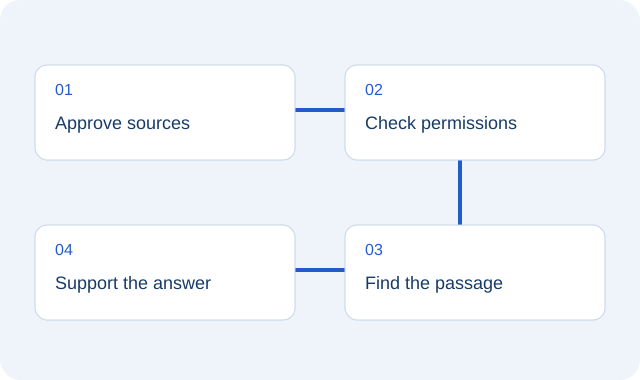
Curate the sources
Shared folders often contain drafts, outdated versions and conflicting statements. Agree which documents are authoritative and who maintains them before building an assistant.
Preserve permissions
A new search interface must not bypass existing access boundaries. People should receive answers only from documents they could also read directly.
Make answers traceable
Source links make review easier but do not replace it. A source may be irrelevant or outdated. Test whether the cited passage actually supports the specific answer.
Allow knowledge gaps
When no reliable source exists, the system should say so and offer a next step. A question passed to a person is more useful than a confidently invented answer.
Start with a small source list
Begin with a manageable set of approved documents. Record an owner, the valid version and the intended audience for each source. A document without a clear owner can become outdated even when search works well. Resolve duplicates and contradictions before integration. Answer quality depends on whether an authoritative basis can actually be found.
Test different user roles
Testing with an administrator account is not sufficient. Ask the same question under different roles and check that confidential sources stay excluded. Consider metadata too: filenames, snippets and search results can disclose information. When access is removed in the source system, the agreed update process must also make that change effective in search.
Separate source quality from answer quality
Search can find a relevant source and still produce an inaccurate summary. Evaluate the steps separately. First: was the correct, current passage found? Second: does the answer reflect its meaning accurately? Third: is it clear which parts of the question remain unanswered? This separation helps identify the cause of failure instead of merely changing the wording of an answer.
Knowledge maintenance is part of operation
Agree how new documents are approved, old versions replaced and deleted content removed. A feedback mechanism for incorrect or incomplete answers supports maintenance but does not replace ownership. Frequently unanswered questions may point to missing documentation. An assistant can then improve access to knowledge while also revealing where that knowledge base needs development.